

let's get physical
no pain no gain???
for the best reading experience click the post’s title above to open in a new page which allows you to hover over the numbered footnotes to read them alongside the text. its one click. JUST DO IT.
My mother is an exercise fiend. It’s what she does to relax and she can barely go 24 hours without putting on the Jillian Michael’s 30 Day Shred DVD or a YouTube HIIT video. She’s been known to do two a day if the first one didn’t stick and to wrangle her grandchildren to join her dance workout sessions. My childhood soundtrack was the dulcet commands of Gilad, the shirt challenged guy from Tae- Bo Billy Blanks, Crunch and Jane Fonda so I developed a respect for physical movement from a young age.
My first foray into focused physical activity was gymnastics as a kid where I expected to be recruited to the Magnificent Seven any day. But after a friend’s mother called me a spider1 I vowed never again to grace the masses with my singular talent. I loathed running laps in gym class with a passion but loved volleyball and played on the school’s team and with the teachers after school.2 In college I visited the gym every so often to ‘use the elliptical’ for the length of an OC episode or two3 and took a semester of Aerobic Walking for PE credit. I added to the complexity of walking around an indoor track for 45 minutes by holding 5lb weights4. I’m bummed now that it never even occurred to me to visit the weight section of that gym. Since then I’ve done various yoga videos5, sign up for various cardio workout programs and the last few years did some light dumbbell work. Which really was just swinging around 10-15lb dumbbells in a variety of ways, sometimes grabbing the 20 for a move or two. But this year I decided that instead of just reading and absorbing information about the immense mental, physical, emotional etc benefits of progressive weight training and muscle building, I’d try it myself. I’d read about Casey Johnston a while back in The Cut and loved her voice and what she had to say, but it hadn’t clicked that this could be for me too. I’m not really sure why. I think doing the same moves every time seemed repetitive and boring. Plus I’d probably just accomplish it all so fast that it would be useless and over as soon as it began. What.
Turns out what I’ve enjoyed about weightlifting is actually its simplicity. The moves aren’t a surprise but it sort of is that I can do them because I increase my weight every time. Whatever I did last time I just push a little bit more6 challenging my muscles and myself which feels immensely satisfying. After a 45 minutes or so I’m done and I feel buzzed, primed and peppy. Sometimes I get chatty and I always get very hungry. It’s a dedicated time to check in with my body, reward and challenge it intentionally and then rest, eat, hydrate and do it all again. I don’t always succeed at the challenge— I had my first fail last month when I kept telling my left arm to finish its overhead press of 82lbs but it flatly refused. A curious, fascinating sensation that wasn’t too much of a problem7 as I could de-load and add more reps until I eventually get there.
I’ve still got many instincts and narratives to unlearn, and will always, but I’ve wholeheartedly enjoyed this activity that is demanding and rewarding in equal measure. So much so that when I had to take two weeks off for some wrist pain I was real crabby. I missed the routine and the languidly energized feeling I’d get after. Plus I wanted my gainz back! Am I a gym bro now!? I hope not, but I do enjoy the little lamp lit loft at my gym which is welcoming to everybody except for ICE.
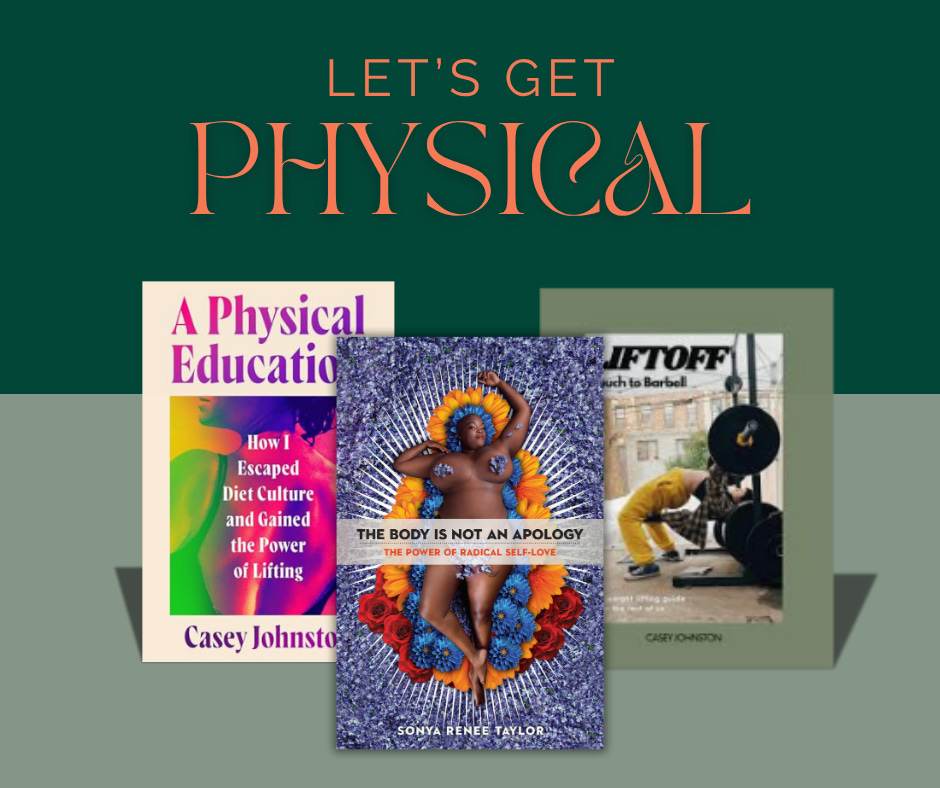
If you’re reading this you have a body.8 Our connection and relationship to our bodies is in constant flux during our lifetimes and is vastly different person to person within our historical, geographical, racial, class, gender etc etc etc contexts. But we do all have the body thing in common! Today’s shelf contains books that explore physicality— a memoir of self discovery, a powerful call to ‘disrobe shame’ and the weight training beginner’s how-to guide that I’ve been using this year.
Extra Credit: How Gendered Myths of Strength Keep Women Weaker
A 2016 study published in Cogent Psychology — covering data from 34 countries and more than 48,000 people — found that women in more gender-equal societies were over three times as likely to engage in weekly physical activity as those in less equal ones. The effect remained strong even after accounting for factors like age, education, and national wealth.
Don’t forget to warm up and cool down as you bulk up your knowledge with one of these.
A PHYSICAL EDUCATION by Casey Johnston
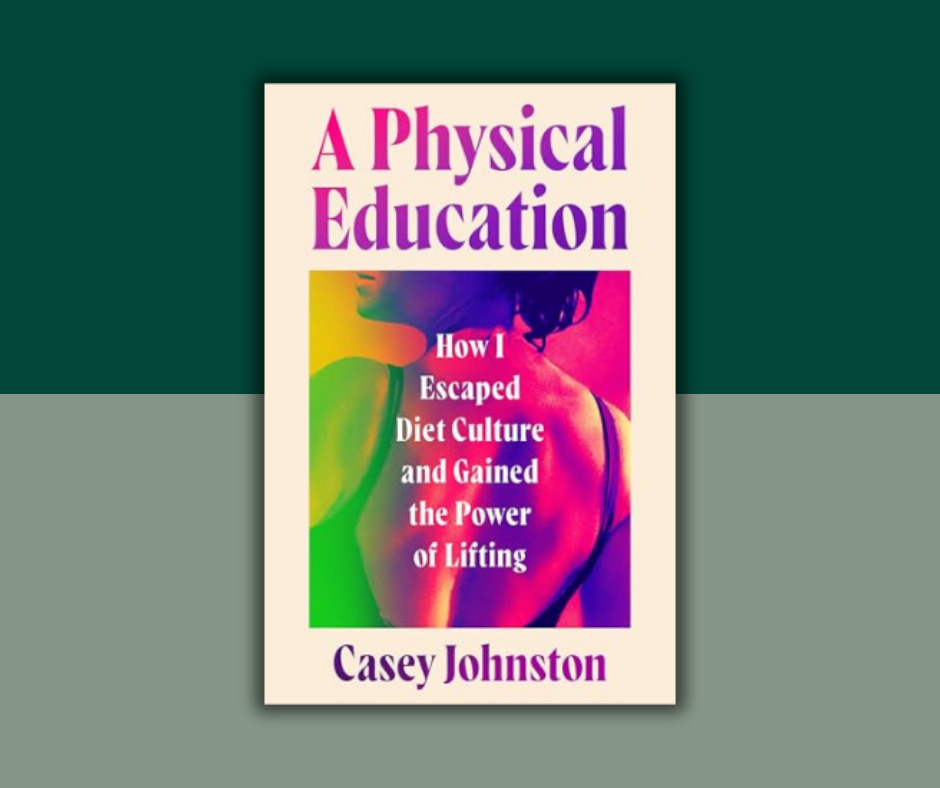
In this memoir by a self professed ‘Swole Woman’, Casey Johnston recounts how weight lifting transformed the way she related to and understood her body and how that mindset shift had impacts far beyond the gym.
I’ve been reading Johnston’s newsletter She’s a Beast for a few years now and immensely appreciate her candor and forthright voice when it comes to demystifying lifting and taking ‘wellness’ culture down a few pegs, so was excited to get to know her backstory more intimately. With a skilled, easy and friendly voice she takes readers through her years of disassociating from her body, the variety of attempts she tried to ‘tame it’ and relates some of these attitudes to broader aspects of her life and sense of self. Her attitude towards her body being something to control and manage like a machine separate from herself was entirely relatable as was her reliance on outside approval metrics for how she viewed herself. She shares how she battled intense skepticism when she decided to pick up some weights instead of running and jumping for hours a day and all the emotions, awkwardness and growth that weight lifting evoked. Her journey from frustration, fear, timidity and intimidation to curiosity, anger9, awe, excitement and appreciation had me cheering her on.
Though she’s an ‘internet’ personality, she isn’t an influencer. At least not how I think of ‘influencer’. She was a journalist so approached weightlifting with tons of study and preparation before she ever entered a gym and takes us through that information along with her own personal changes— physical yes, but also mental and emotional. As someone who also approaches new things with lots of study I really appreciated how she communicated this information in a relatable, understandable and entirely realistic way.
Doing everything I’d feared has allowed me to become exactly what I’d dreamed.
I cheered often and said “YES” aloud many times while reading this, feeling proud of Johnston’s journey like she was my real life friend. I was buoyed by her experience of embracing bodily intuition, building strength, dealing with failure in healthy ways, battling perfectionism and discovering a whole community of people who have a radically different relationship to their body and strength than is typical in this day and age. I sincerely appreciated her addressing the things that can often keep women back from weight lifting,10 how our cultural definition of ‘strong’ defaults to the traditional male idea of strength when there are other definitions available, the relationship between body empowerment and trauma recovery11 and this book fueled my desire to take up weight lifting myself.
I was my own most acutely attuned hater under the guise of being my most dedicated protector from criticism.
My quibbles here were that once in a while insider lingo wasn’t as adequately explained as I wanted and I hoped for some more insights in why she made this arena her new career focus, what official qualifications she earned and was left wondering why she doesn’t mention Liftoff, her weight lifting program that we’ll get to below. Story wise I think there were some unresolved personal topics that were introduced but not delved into fully. Perhaps they’d have been more clear if this was a more traditional memoir— but because its focus is her weight lifting journey maybe this stuff didn’t fit into the word count? If you are curious at all about weight lifting or retooling your own understanding of your body I highly recommend reading this and signing up for her weekly newsletter as well.
Extra Credit: Casey Johnston on Julia Turshen’s podcast
Before lifting, I had not once thought of myself, my body, as a mutable, habitable living thing. I had not even really thought of myself as my body. It was as if it had been a separate, unruly alien entity that I had to wrangle into submission, putting it through one obstacle course after another, wanting it to earn my approval, only to find it always falling short. (Often, the purpose of these entire exercises seemed to be setting the bar high enough that my body would always fall short.) I only allowed it to be useful as a vessel for tension, for the physical manifestations of dread and panic.
the rolling ladder is a weekly ritual that brings you amusement or adds a new book to your nightstand then
read a book! - heart! - share! - comment! - or even buy me a ‘coffee’
THE BODY IS NOT AN APOLOGY by Sonya Renee Taylor
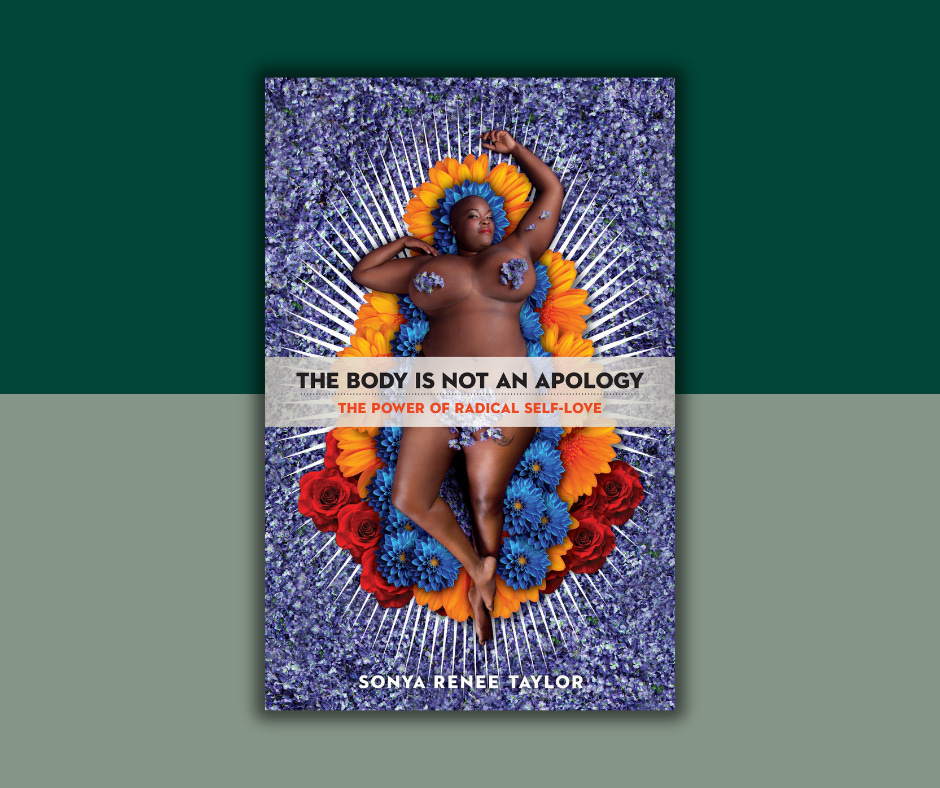
Our relationships with our own bodies inform our relationships with others.
As one of the ‘mid-wives of the new world’ Taylor explains her worldview of ‘radical self love’ — what it is and ‘what it ain’t’ before asking direct questions about where and why we learned to apologize for our bodies. She asks the reader to look deeper into who benefits from our body shame and who would it instead benefit if we… stopped doing that. Not just for our individual selves but collectively as humans. She begins by sharing how the origin of the phrase ‘the body is not an apology’ erupted from her during a personal interaction and how it has since sparked her campaign for a way to radically shift the world starting with individual change.
Honestly, the term ‘radical self love’ made me cringe a little. It felt woo woo and perhaps a bit foolish. Whereas in the past this would cause me to avoid it all together, instead I noted this, asked why I felt this way and then moved toward it anyway. So the fuck what if its silly or woo woo!? These are actually elements I’m trying to add into my life to combat decades of christian fundamentalism! So I thanked my initial reaction for its service and set it aside as I read and was truly rewarded by Taylor’s wisdom, optimism and tenacity. I’ve been looking to add more of the feminine into my understanding of spirituality, culture, history etc and this caring, appreciative rising tide of an idea fit right into that quest. This was powerful, moving and enriching. Sort of how I wish church sermons would be.12 Indeed some of her thoughts here about speaking truth to power, rebelling against religious leader’s dogma, focusing on the love, acceptance and value of all bodies sounded actually kind of familiar….
Health is not a state we owe the world. We are not less valuable, worthy, or lovable because we are not healthy. Lastly, there is no standard of health that is achievable for all bodies. Our belief that there should be anchors the systemic oppression of ableism and reinforces the notion that people with illnesses and disabilities have defective bodies rather than different bodies. Each of us will have varying degrees of health and wellness throughout our lives, and our arbitrary demands and expectations as they relate to the health and size of people’s bodies fuel inequality.
This is meant to be interactive as it includes ‘Unapologetic Inquiries’ to ask one’s self as Taylor explores the origins of body shame, media complicity, consumer culture, government messaging and ‘body terrorism’. She shares facts, anecdotes and thought exercises along with her goal of fostering ‘radical self love’ through a ‘disrobing of shame’, the Three Peaces13 and fighting with love.
I appreciated her inclusion of the idea of ‘poodle science’ (above) as a thought experiment was continually struck by how simple but significant her message is. I grew more and more angry that this is like a controversial topic as evidenced by just the sampling of anti-body laws she lists 14 and ended this book with much to think about and full of gratitude for Taylor’s work. She rightly points out how our relationship with ourselves reflects and feeds into our relationships with others so I couldn’t help but wonder: if a worldview filled with supremacist views, self flagellation, unattainable metrics and perhaps a sprinkling of total depravity could actually lead to de-humanizing other bodies?
A radical self-love world is a world that works for every body. Creating such a world is an inside-out job. How we value and honor our own bodies impacts how we value and honor the bodies of others. Our own radical self-love reconnection is the blueprint for what author Charles Eisenstein calls ‘The More Beautiful World Our Hearts Know Is Possible’. It is through our own transformed relationship with our bodies that we become champions for other bodies on our planet. As we awaken to our indoctrinated body shame, we feel inspired to awaken others and to interrupt the systems that perpetuate body shame and oppression against all bodies.
Also potent was her call out of consumerism and purchasing power noting that “Body shame flourishes in our world because profit and power depend on it” and encourages readers to perform some deep self-inquiry about our motivations before clicking Checkout. Why do we want this? Who profits from our purchase? Will we feel as worthy without the item? Though this idea of self love, anti-shame and the worthiness of all people is so so simple, apparently it is not so easy. This is a 130 page powerhouse of a message that I highly encourage you to pick up if you or someone you love has a body.
A particularly strategic maneuver is to decide that if we don’t understand something it must be wrong. After all, wrong is simpler than not knowing. Wrong means I am not stupid or failing. See all that sneaky, slimy projection happening there? Projection shields us from personal responsibility. It obscures our shame and confusion and places the onus for reconciling it on the body of someone else.
We don’t have to work to understand something when it is someone else’s fault. We don’t have to undo the shame-based beliefs we were brought up with. We don’t have to question our par-ents, friends, churches, synagogues, mosques, government, media. We don’t have to challenge or be challenged. When we decide that people’s bodies are wrong because we don’t understand them, we are trying to avoid the discomfort of divesting from an entire body-shame system.
LIFTOFF: COUCH TO BARBELL by Casey Johnston
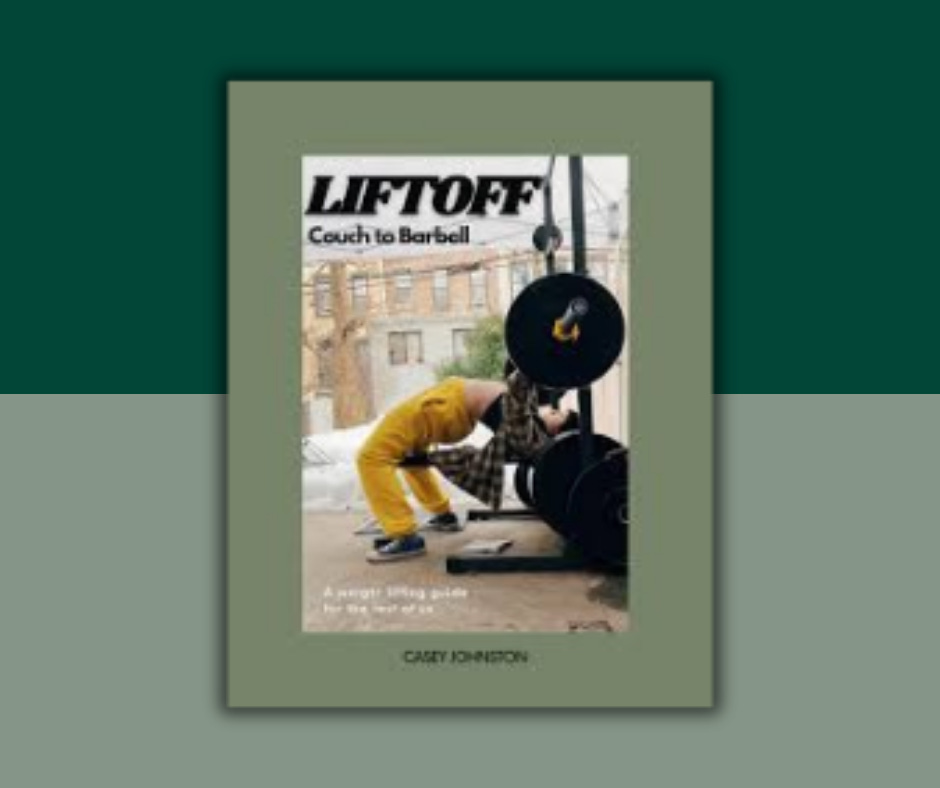
This $20 ebook15 is Casey Johnston’s16 12-week weight lifting program and aims to answer the questions “How did you get started?” and “How did you keep going?”. Johnston keeps it practical, focusing on how basic strength training will ‘translate extremely well to the pushing, pulling, carrying and picking up you do in real life” and highlights progressive overload, recovery efforts, compound movements and intentional form.
I read this book cover to cover, but that’s because I was brand new at weight training and wanted to feel as informed as possible before starting.17 This begins with a chapter on ‘The quick and dirty spiritual rules of LIFTOFF’ followed by the introductory sections- How To Use This Book, Why should I learn to lift? The goals of LIFTOFF, Who is this program for? and What’s going to happen to your body? before getting into the broader aspects of the program and specific movements. There are sections on the overall program structure, the core principle of ‘weights go up’, warm up how tos, cues and breathing notes. Then it goes into each of the 3 phases which include illustrations of each movement, notes and links to videos. The book and videos are well done but are endearingly under polished which I thoroughly appreciated. I find that this anti-sleek vibe added to the ‘jump in and try’ approachability of the entire enterprise. She’s isn’t wearing a shiny, matching set from lululemon while promising you six pack abs in three days from inside a muted grey room with pops of millennial pink.
The first 2 phases can be done at home with dumbbells but you’ll need a gym for the final one, unless you’ve got a barbell setup at home. After detailing the 3 Phases she has a few different chapters dedicated to the gym— demystifying this sometimes intimidating activity with notes about visiting it first, doing a dry run and where to start your weights as you graduate from dumbbells to barbells. The book ends with all sorts of practical tips, the kinds of things you’d ask an experienced friend, like recording your workouts, failing, spotting, a note about overhead press18, deadlifts, squat depth and What’s Next. She ends with an Appendix explaining all the terms, insider lingo and vocabulary you’ll need to get a good grip19 on all this.
I started this program this May, and though I had thrown around 15lb dumbbells for years before in a haphazard fashion, I started this from zero because I figured following the exact program would allow me to see true, gradual improvement.20 I finished the first two phases then started going to a gym in August. Though I was irked to take off a couple weeks21 last month, as of this week I’m at the below for my lifts22. Putting this out there because, as a beginner, I go heavier each session so next week the numbers will (most likely) be even higher. Cool right?
OVERHEAD PRESS - 72lbs
LAT PULLDOWN - 105lbs
DEADLIFT - 130lbs
SQUAT - 117lbs
ROW - 90lbs
BENCH PRESS - 100lbs23
This program is supremely satisfying to do, witness and experience! I’m always excited to go lift, to take the time to check in with my body and notice if I’ve been eating, sleeping and hydrating enough to do my 2.5-5lb jump. After a certain point it is now almost always difficult,24 BUT like a good, thrilling and satisfying difficult. Do you know what I mean? Building strength like this has been surprisingly exciting— to set a new challenge level for myself each time and work to reach it. Plus my shoulders are looking real nice lately. I hope this encourages anyone whose interest is piqued to give it a go and see if you enjoy it. I started at 0 and so will you. But you won’t stay there! If you’re weight curious but still on the fence, take a look at the no-nonsense, helpful FAQ at the bottom of this page.
Quick tidbit- While I used a paper printout initially to keep track of my numbers, now I use the HEVY app which I love most especially because it has a little ‘calculate’ button so I don’t have to math my way to adding plates to the barbell. Happy lifting!
Extra Credit: Women and Muscle Deep Dive
I made LIFTOFF because I think everyone can learn something from lifting weights. Lifting weights isn’t just about raw strength, and it’s not just for the people who are pre-ordained to be strong. It’s also about having a constructive, positive-feedback-loop relationship with your body. It’s about mobility; body mechanics; and managing, or even heading off, the pain we may experience from moving too little in the ways we “are naturally good at. And, okay, it’s also about how fucking good it feels to be strong.
Did you know I do more than read and tell you what to read? I also edit podcasts and fiction. If you’ve got an audio project that needs a skilled ear or a fiction manuscript that needs a detailed eye, send me a message, or leave me a comment.




what physical/body focused books would you add to this shelf?
do you do progressive weight training too? any resources to share with me/the group!?
due to my elbow to knee black leotard and my excellent bridge form
it was hard to get rid of me because the school was also my home
californiaaaaaaaaaa
i was very cool
like most people i did yoga with adrienne for a while until i couldn’t stand her dog video bombing anymore. like, this is your place of work ma’am.
1-5lbs depending on the move
i mean i was bummed and like ‘what did i do wrong’ for a bit but it is part of the process. read on.
fuck you AI
at the fitness lies we’re sold
like fear of being ‘bulky’, and the presence of irritating gym bros
In Trauma and Recovery, Herman writes about the importance of empowerment in rehabilitating from trauma, especially in developing autonomy and “engaging more actively in the world” as a counter to feelings of helplessness and isolation. Specifically, Herman cites “a conscious choice to face danger” as a kind of controlled sandbox for developing new responses and “rebuilding the ‘action system’ that was shattered and fragmented by trauma.”
As a result of experimenting with danger, survivors “may begin to question previous assumptions. ...Women question their traditional acceptance of a subordinate role. Men question their traditional complicity in a hierarchy of dominance.”
Lifting was, perhaps, the danger sandbox that I needed: controlled but unfamiliar. Challenging and uncomfortable, but tolerable. Most of all, it was easily scalable to my level —thirty pounds too heavy? Twenty will do.
make peace with not understanding
make peace with difference
make peace with your body
“Legislating body shame is not a draconian practice of centuries bygone.”
another way i see her lack of typical ‘influencer’ vibes is that Johnston seems to refuse to have a coherent brand umbrella as she writes under her own name as well as “Swole Woman”, “She’s a Beast” and “LIFTOFF”. i find this somehow endearing in its scrappiness and atypicality.
some procrastination may have been involved too
damn you OHP!!!! jk. this was helpful because what she prophesied was exactly true.
this is not a pun. i don’t do puns.
also because i’m a recovering rule follower and fundamentalist
i did something to my wrist cartilage, tfcc, but i’m still not sure when or how… it may have been the gym but it could also have been… opening a jar? luckily i got the go ahead to keep lifting just with a wrist brace. don’t let this stop you is what i’m trying to get at.
wow abby, way to go!
these may not be impressive to you, but their impressive to me and this is my newsletter. ergo.
how difficult it feels has much to do with recovery efforts AND menstrual cycle days. something i keep notes about.
I love that
Somehow ..
Somewhere ….
I’ve inspired you !!!
💕💕💕💕💕hee hee