

rebecca, revisited
last night i dreamt i went to manderley again. or was it menabilly?

“what sweet madness is this”1 was the comment I left on Carmen Maria Machado’s2 January newsletter post3 where she promoted a pilgrimage she’d be teaching in Cornwall all about the book Rebecca. Reader, I signed up that day. Usually averse to toured expeditions,4 I had an inkling that this one may be an exception. Common Ground Pilgrimage’s ethos hit on many of the elements I’ve recently been incorporating into my life— namely finding the sacred in the ordinary, cultivating hierophany with literature5 and prioritizing personal connections. I was owed a retreat after my husband took a seriously nerdy trip to Egypt last year to learn more about the Gnostic Gospels, but the bookish ones I kept finding were all “Read A Court of Thorns and Roses with us on yacht in the Adriatic with bottomless mimosas!” Not offense to the Maas-heads out there, but that wasn’t quite the vibe I was looking for. Turns out the Substack algorithm knew exactly what I was looking for and served me Carmen Maria Machado + Rebecca + Cornwall + a connection to Not Sorry Productions6 + a group of fellow readers + reading as a sacred practice + “the ancient practice of pilgrimage”.
So last month, after a three week long train trip down the Pacific coast, I flew to London, stopped at Daunt Books to buy a copy of Rebecca, and (barely)7 caught the train to Cornwall. In an almost empty train car with spectacular views whipping by, I skimmed the book and used my neon pink pen to underline all the parts that caught my eye.

The jig-saw pieces came together piece by piece, the real Rebecca took shape and form before me, stepping from her shadow world like a living figure from a picture frame. Rebecca slashing at her horse; Rebecca seizing life with her two hands; Rebecca, triumphant, leaning down from the minstrel’s gallery with a smile on her lips.
At Par’s tiny train station I met my 24 fellow pilgrims and we bussed to Fowey Hall where, almost immediately, I knew I had chosen wisely. The first night, after a few silly ice breakers, we read the first chapter of Rebecca aloud and practiced lectio divina8 as a way to interpret and experience the text. CMM, using a bright green marker, filled up a large sketchpad sheet with all of our observations, guesses and analysis9 as we all traveled back to Manderley’s grounds with the second Mrs de Winter.
The rest of the week was filled to the brim with book discussions, muddy hikes, glorious flowers, misty trails, sage guidance10, sparklets11, hearty meals and conversations with some of the most interesting, intelligent and unique people I’d ever encountered. Not usually a talker, I was greedy to speak with everyone in the group and finished the week craving another so I could learn more about each and every one of my fellow pilgrims. We spent our mornings in class— a roundtable discussion where we dissected themes from the book and truly, this felt more holy than any bible camp chapel I’d been to in my youth because we were all presenting our ideas and really listening to and connecting with the others instead of mindlessly regurgitating the one interpretation the leader wanted to hear. Everyone brought their own perspective and then built on each other’s as we discussed experimental certainty12, dreams, youth and the self, romance and relationships, the ‘extraneous’13 woman, gothic as the past colliding with present, Rebecca’s bisexuality, Max’s motivations and how Mrs. Danvers may be more like the second Mrs de Winter than she’s comfortable with.14 Rebecca was such an ideal work for this type of group examination because there’s so much we aren’t told outright and can see only shadowed, slanted or in between the lines. I could not get enough of this back and forth and round and round book talk; to me it was special, sacred and thrilling. I learned so much from the others and hopefully contributed a couple interesting ideas in there as well.
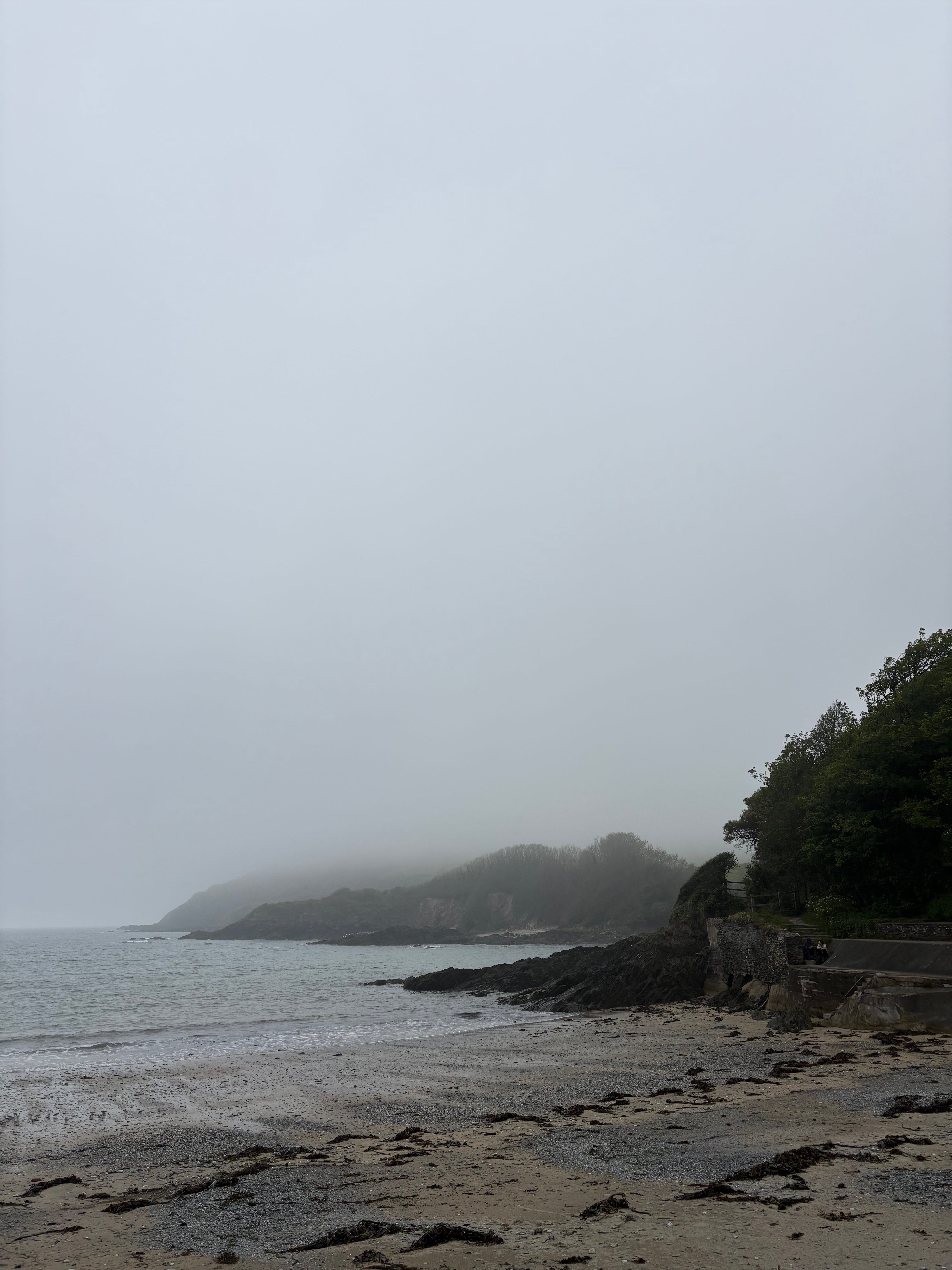
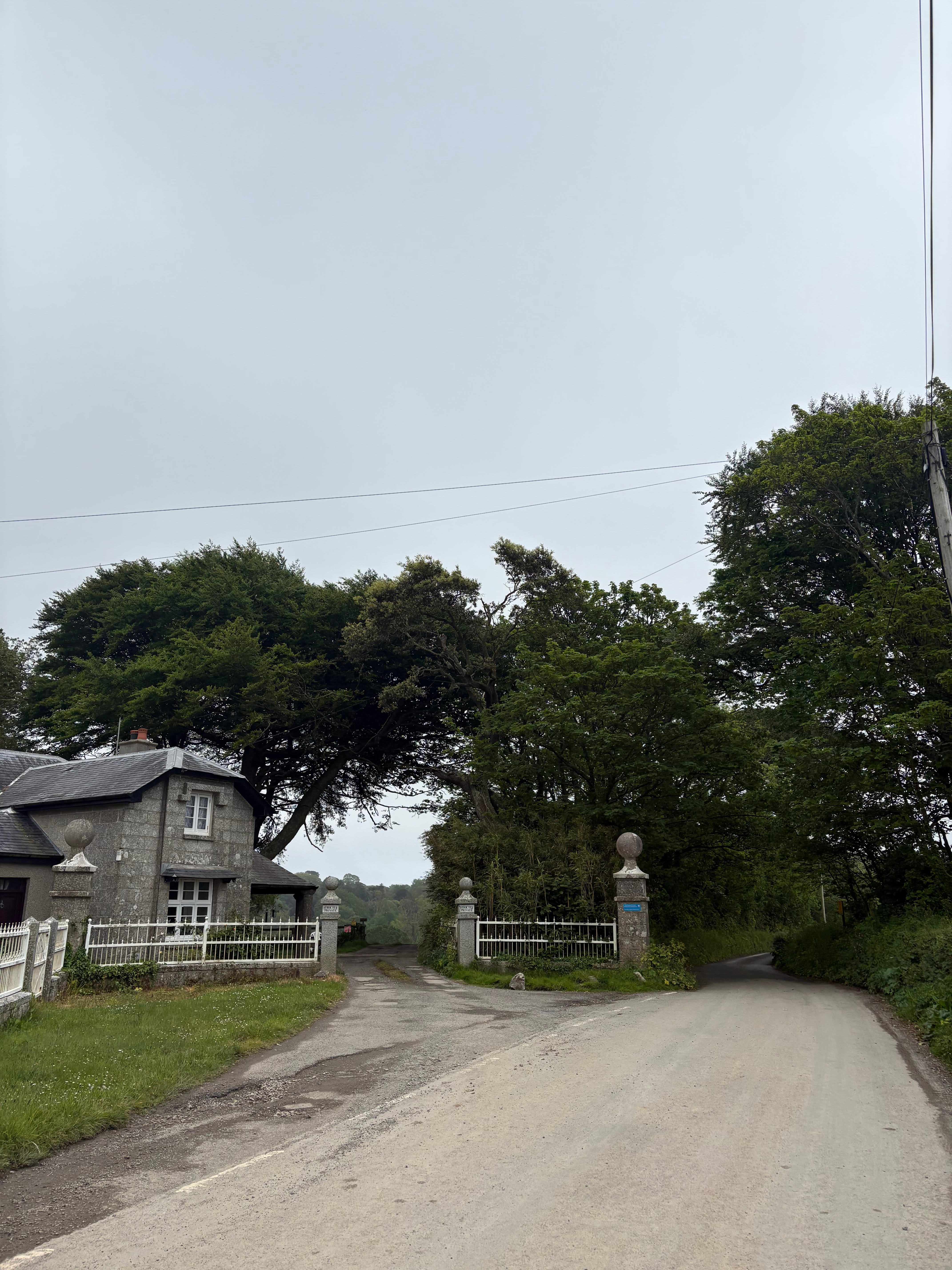
The setting of Fowey on the Cornwall coast only increased the moody, literary ambiance as this is where Daphne du Maurier spent many years and wrote much of her oeuvre. We ate dinner at the real Jamaica Inn, which had a little DdM exhibit, and passed Menabilly’s gates on one of our walks. Menabilly being the estate that so entranced15 du Maurier that it inspired Manderley and was her home for over two decades. There’s much more I hold dear about this trip, but I don’t want to make you all too jealous so I’ll spare you. Below is the Rebecca shelf that was first posted in August of 2024. Re-reading it just now I was struck by what turned out to be a prophecy16: “I think it would be an especially chilling read at a coastal retreat on a rainy day”.
rebecca
originally posted on 8.27.2024
An isolated, sprawling house that meets a fiery end. A brooding, older man plagued by dark memories is saved from death by a plain, orphaned young woman who yearns for more from life. A disapproving housekeeper. A first wife that haunts the halls.
In the last post I teased another Gothic novel that borrowed several beats from Jane Eyre, but succeeds completely on its own merits. An instant bestseller, Rebecca was published in 1938 and continues to sell thousands of copies to this day; enthralling readers with its sumptuous descriptions of a home, relationship and mind haunted by the past, full of suspense, horror and surprises. The basic story follows a nameless narrator who impetuously marries a rich widower and moves into his estate finding that it continues to be in the thrall of his late first wife, Rebecca. Mystery, moodiness and madness ensue.
“Rebecca, always Rebecca. Wherever I walked in Manderley, wherever I sat, even in my thoughts and in my dreams, I met Rebecca. I knew her figure now, the long slim legs, the small and narrow feet. Her shoulders, broader than mine, the capable clever hands. Hands that could steer a boat, could hold a horse. Hands that arranged flowers, made the models of ships, and wrote “Max from Rebecca” on the flyleaf of a book. I knew her face too, small and oval, the clear white skin, the cloud of dark hair. I knew the scent she wore, I could guess her laughter and her smile. If I heard it, even among a thousand others, I should recognize her voice. Rebecca, always Rebecca. I should never be rid of Rebecca.”
Though it was marketed as a romance, this is a psychological thriller dealing with themes of jealousy, power, class and gender roles inside a heightened, melodramatic location with a maddeningly lame protagonist who doesn’t even get a name of her own. Though similarly orphaned, poor and plain, the narrator of Rebecca is the anti-Jane Eyre; exhaustingly insecure, overly-sensitive17, submissive and spineless she suffers from a massive inferiority complex that only worsens as she is constantly pitted against the infinitely charming, competent, lovely and dreamy perfection of Rebecca. While both novels are in the first person, we know Jane Eyre’s name before reading a single word of her ‘autobiography’ yet we never discover the name of Rebecca’s narrator, though we do get a few cheeky allusions to her “unusual name” that Mr. de Winter spells correctly which is “rare”. Jane is sure of her self worth, integrity and morality in spite of her surroundings and Rebecca’s narrator is malleable, pathetic and ready to throw ethics out the window in exchange for the barest drop of love. Compare and contrast the narrator’s reaction to the big revelation in Rebecca to Jane’s reaction when Rochester declares they should live together unmarried.
Both women are artists of a sort, but Rebecca’s narrator’s real talent lies in her fanciful, pages long daydreams where she lets her anxiety and flair for the dramatic entirely triumph over logic and reason, driving her into frenzies that the Manderley estate is only too ready to serve as a backdrop for. She knows about the first wife; indeed Rebecca’s existence is practically the first fact she learns about de Winter while Jane is haunted by but oblivious to the existence of Rochester’s first wife Bertha. Actually, it could be interesting and provocative to explore the various dynamics that Rebecca and Bertha share…18 The narrator does have a bit of an arc, though what it takes to get her there is still pretty passive. A fun bit of trivia: Joan Fontaine played both the narrator in Alfred Hitchcock’s Rebecca and Jane in Jane Eyre three years later.
Rebecca would never grow old. Rebecca would always be the same. And she and I could not fight. She was too strong for me.
The romance is also quite opposite. While Rochester can be an ass, I believe he truly loves Jane. But, Maxim de Winter is truly terrible in his weaponized bland obliviousness and vague imitation of care.19 He ignores, mocks and diminishes the narrator, often calling her an idiot and his proposal leaves much to be desired20 , yet she pitifully continues to cling to him and their ‘love’ debasing herself all the while.
I was transfixed by the shadowy, mercurial atmosphere of Manderley, the ominous chapter endings and all of Mrs Danvers’ mannerisms and sabotage. Often there aren’t descriptions for the dialogue delivery, leaving it up to the reader to infer emotions and the entire novel demands interaction21 as you read between the lines. Though presented fairly straightforward by the end, from a very biased first person perspective, reflections on the actions of these characters will show that all is quite murky, nuanced and layered which invites repeated readings and conversation. The writing is immersive, beautiful and captivating and its terrifying visuals, well paced plot and gloriously scenic writing of place and mood keep upping the tension to create a mesmerizing, eerie allure that will keep this book cemented as a true Gothic22 masterpiece.
She stared at me curiously. Her voice dropped to a whisper. "Sometimes, when I walk along the corridor here, I fancy I hear her just behind me. That quick, light footstep. I could not mistake it anywhere. And in the minstrels' gallery above the hall. I've seen her leaning there, in the evenings in the old days, looking down at the hall below and calling to the dogs. I can fancy her there now from time to time. It's almost as though I catch the sound of her dress sweeping the stairs as she comes down to dinner." She paused. She went on looking at me, watching my eyes. "Do you think she can see us, talking to one another now?" she said slowly. "Do you think the dead come back and watch the living?”
As a book lover, it hurts me to admit that my first time reading this treasure was this past spring, but that’s the truth of it. I knew the Hitchcock film23 but as always, the book is infinitely better and I highly recommend it.24 I think it would be an especially chilling read at a coastal retreat on a rainy day but I’ll accept anytime, anywhere. Today’s shelf contains three homages to Rebecca and, though they are not as meticulously crafted25, their narrators have a bit more spark and gumption while their settings are just as beautifully creepy as Manderley.
Dismiss the housekeeper and keep away from candles as you step into one of these Rebecca themed stories.
THE WINTERS by Lisa Gabriele

After her beloved father’s death, our narrator26 works a thankless job at a charter boat company in the Caribbean with little ambition, comfort or love in her life. When a client, the widowed and wealthy Max Winter, takes an interest in her and proposes after just weeks of clandestine trysts, she jumps at the chance for a new life; an escape from her loveless existence full of grunt work and sad memories. Upon arriving at the expansive Asherley estate27, she discovers just how out of her depth she is as her soon-to-be step daughter Dani mocks and stonewalls her at every turn. Not helping matters is the constant presence of the deceased first Mrs Winter, Rebekah; the long shadow her memory casts upon the house and family eventually invades the narrator’s own body, mind and sense of self. When Rebekah’s influence begins to reach beyond the grave, our narrator is confronted with truths, lies and decisions that will dictate the future of her and her long hoped for new family.
This is the rare domestic thriller that worked for me; probably because it is a modern take on a classic but still includes its own deliciously twisted surprises from its opening line28 to its closing chapter. Max and our narrator’s relationship, while still vastly unequal, is sexy and full of chemistry and lively banter so feels more tangible and worthy of emotional investment. The narrator has a bit more backbone, wit and sense of self than her Rebecca parallel and her intense insecurity and imposter syndrome completely aligned with the drastic change in her circumstances; from service worker to the fiancé of a US Senator living on an opulent private island. The writing is well paced, affective and atmospheric while the clever reinvention of Rebecca’s ingredients flow well in the narrative and are fun to spot. We’ve got Dani as an evil stepdaughter29 devoted to the memory of Rebekah, an overbearing, tacky boss who attempts to derail the budding love affair, a mysteriously boarded up green house30 , some of Rebecca’s famous scenes reimagined to perfectly cringeworthy effect31 and, of course, a fire. This is suspenseful, full of building tension, secrets and drama- an thrilling reinterpretation that will still pack surprises for fans of the original.
But I had done this to myself. I had invited her in. In my darkest days, I sometimes had to remind myself that it started here, in that moment, and that it wasn’t Rebekah who came after me. I was the one who went looking for her.
FAKE LIKE ME by Barbara Bourland

After a warehouse fire destroys her painstakingly crafted paintings, based on the seven virtues, that were destined for a career defining gallery show, an artist desperately searches for a way to recreate them. Her one chance lies at the infamous artist retreat, Pine City, run by a group of friends who are darlings of the art world that she’s long revered. The legendary Pine City has immense reach and resources though its never regained its former glory after its most lauded artist, Carey Logan, tragically drowned there years before. As our nameless artist toils away to reconstruct her paintings in the same spaces Carey lived and worked, she begins to fall in love with Carey’s boyfriend, forge connections and enemies with the collective and investigate the mysterious circumstances surrounding her counterpart’s life and death which ultimately leads, she fears, to the unraveling of her own sanity.
I didn’t start this one knowing it was Rebecca inspired. I had added it to my library queue since I loved The Force of Such Beauty32 by the same author and little by little recognized some familiar themes. It finally clicked about a third of the way through and I felt a tad silly not to have realized it before. In my defense I hadn’t yet read Rebecca at that point, just knew its beats, and this setting is wildly different though retains the seductive, gloomy vibes of Manderley . The exclusive art world and its snobby members created a perfect environment for our main character to be a perpetually jealous outsider, desperately seeking acceptance and praise. This started a bit slow, and even a tad intimidating, with its intricate descriptions of specific mediums and techniques but the pace and tension picks up once the artist is thrown into the oblique and aspirational world that is Pine City. There she is haunted by the macabre art of the ‘first wife’ figure, Carey, whose disturbingly realistic sculptures of dead bodies litter the rooms where she sleeps and works, literally possessing the space with reminders of how much less of an artist she will always be. There is a Mrs Danvers stand in, a romance with Carey’s partner, a fire, misidentified bodies, murky conspiracies and a few scene homages to Rebecca including an accidental Carey cosplay sequence. The sections are divided and titled for the seven virtues that our artist is re-painting, adding a dynamic and intriguing layer of interpretation. I respected the time, research and attention the author put into exploring the talent and labor that goes into these specific creations and especially loved the word choices for color throughout; words like apricot, ash and maple felt distinctive and easily imagined. I wouldn’t categorize this as a gothic thriller in its overall delivery, but it is puzzling, twisty and consistently engaging.
I reminded myself that I had felt the weight of chastity, once. I had felt the forced perspective of humility, the delirium of purity, the rage of temperance, the blinding resentment of obedience, the shame of modesty, the regret of prudence. I had felt the burden of all those words on my body, in my body, through my brush; I could do it again. I was thirty-four years old and I was going to get my work done, and I was going to keep forming the life that belonged only to me.
THE HACIENDA by Isabel Cañas

Set in 1823, just after Mexico’s War for Independence, Beatriz’s life is completely upended when her father is executed as a traitor, her family home is destroyed and she seeks refuge with cruel relations. When the rich and handsome Rodolfo proposes, she leaps at the safety and security that his country estate, Hacienda San Isidro, will provide and ignores the rampant speculation about his first wife’s mysterious death. However, it becomes immediately clear that all is not safe and secure at her husband’s estate; not when the house oozes menace, not when the air itself is supernaturally cold, not when disembodied voices, horrifying visions and unexplained phenomena haunt her waking and sleeping hours luring her deeper and deeper into madness. With Rodolfo called away and nowhere else to turn, she seeks help from a young local priest, Andrés, who has secrets and motivations of his own to purge the house of its malevolence. As the hauntings grow more violent, Beatriz and Andrés’ connection deepens in their quest to uncover the mystery and heal the wounds of the house before it overtakes them.
Rebecca + Hot Priest + Mexican Gothic + folk magic = The Hacienda. This is well written, spooky, atmospheric and engrossing. It isn’t a direct Rebecca homage, rather it includes a few of the classic elements inside a brand new setting which was fascinating and refreshing. We’ve got an unfriendly housekeeper, a fire, an ever present specter of a first wife and a home seeped with beauty and unknown dread but we also get forbidden romance, ghosts, folkloric witchcraft, a heroine with a backbone33 and themes of inherited trauma, the violence of colonialism and a second POV in Andrés. Their team up is illicit and sexy; full of darkened corners, saving each other and confronting fearsome things by candlelight. This reaches a terrific level of terrifying with truly scary visuals inside its seriously disturbed haunted house.
The author played well with themes of misogyny, race, economics, colonialism and religious oppression from a tumultuous era I knew almost nothing about. Cañas was inspired by the unquiet feeling she’d experienced in some of her childhood homes: “I still fear the intimate horror houses see and keep, what grudges build over decades and stain their walls like so much water damage” and wanted to portray a “house haunted by both the supernatural and its colonial history… Colonialism has carved the landscapes of our homes with ghosts. It left gaping wounds that still weep.” Read this one inside a creaking old house on a dark and stormy night with a glass of smoky mezcal within reach.
The rainy season was ending; the garden should have been shades of emerald at this point in September, but what scarce vegetation grew in the outer courtyard was as brown as the earth…Rotting birds of paradise crowded in scattered beds, their heads submissively bowed before us as our boots crunched up the gravel path. The air felt heavier inside San Isidro’s walls, thicker, as if I had stepped into a strange, soundless dream, where the stucco swallowed even the songs of the birds.





do you have any other Rebecca-esque books to add to this list?
stolen from Mr Rochester’s exclamation at the end of Jane Eyre “What sweet madness has seized me?”
an author i very much admire whose memoir In the Dream House is on the hungry hungry homes shelf
as an introvert whose relishes her personal autonomy
Through immersive retreats, we weave together reading, writing, and walking so participants have the space to explore themselves through a particular text alongside a small group of fellow meaning makers.
These journeys aren’t typical travel. They are designed with one clear goal: to meet the spiritual needs of our participants. Through community, rigor, and ritual, we treat traditionally secular things — like novels, walks, or writing — as sacred. In this practice we exercise empathy, courage, and hope, and move closer to treating one another as sacred too.
Not Sorry Productions is a feminist organization that produces podcasts, educational content, live shows, and immersive experiences with the explicit goal of addressing the spiritual needs of its participants. Through community, rigor, and ritual, we treat traditionally secular things as if they were sacred.
they created the popular Harry Potter and the Sacred Text podcast among others.
paddington, why did you announce the platform for the 9:03 to Par at 9:01!?!!
“divine reading”
‘she possesses the vegetation’, ‘pathetic fallacy’, ‘erotic’, ‘nature vs. civilization’, ‘agency but also observer’, ‘whole novel is in first chapter’, ‘creepy and creeping’, ‘deceptive nature of memory’ etc
if you find yourself in cornwall and in need of a walking guide, look no further than lucy daniel.
did you know a group of goldfinches is called a ‘charm’?!
madwoman: check!
perhaps the reason Mrs Danvers is so egregious to the narrator is because she sees some of herself in her? is she repulsed to witness the slavish devotion, leeching proximity to power and meek tolerance of mockery the second Mrs dW endures at Max’s hand because Mrs Danvers had this same relationship to Rebecca? fun stuff right?!
“Perhaps it is wrong to love a block of stone like this, as one loves a person. It cannot last. It cannot endure. Perhaps it is the very insecurity of the love that makes the passion strong. Because she is not mine by right. The house is still entailed and one day will belong to another.”
or at least a manifestation
“Hyper sensitive, a martyr to my own inferiority complex”
i’m sure its been done before but maybe i’ll take a stab at it myself sometime
“I'm asking you to marry me, you little fool.“
perhaps even complicity
a favorite genre of mine
skip the netflix version. lily james is sorely miscast
obviously
a nation’s favorite book is a hard act to follow
poor, obscure, plain and little?
on its own private island
“Last night Rebekah tried to murder me again.”
honestly more frightening than a housekeeper
vs a boat house
but contain their own creative details
from the princess diaries shelf
and a name!
You captured it all so perfectly, the nostalgia is killing me